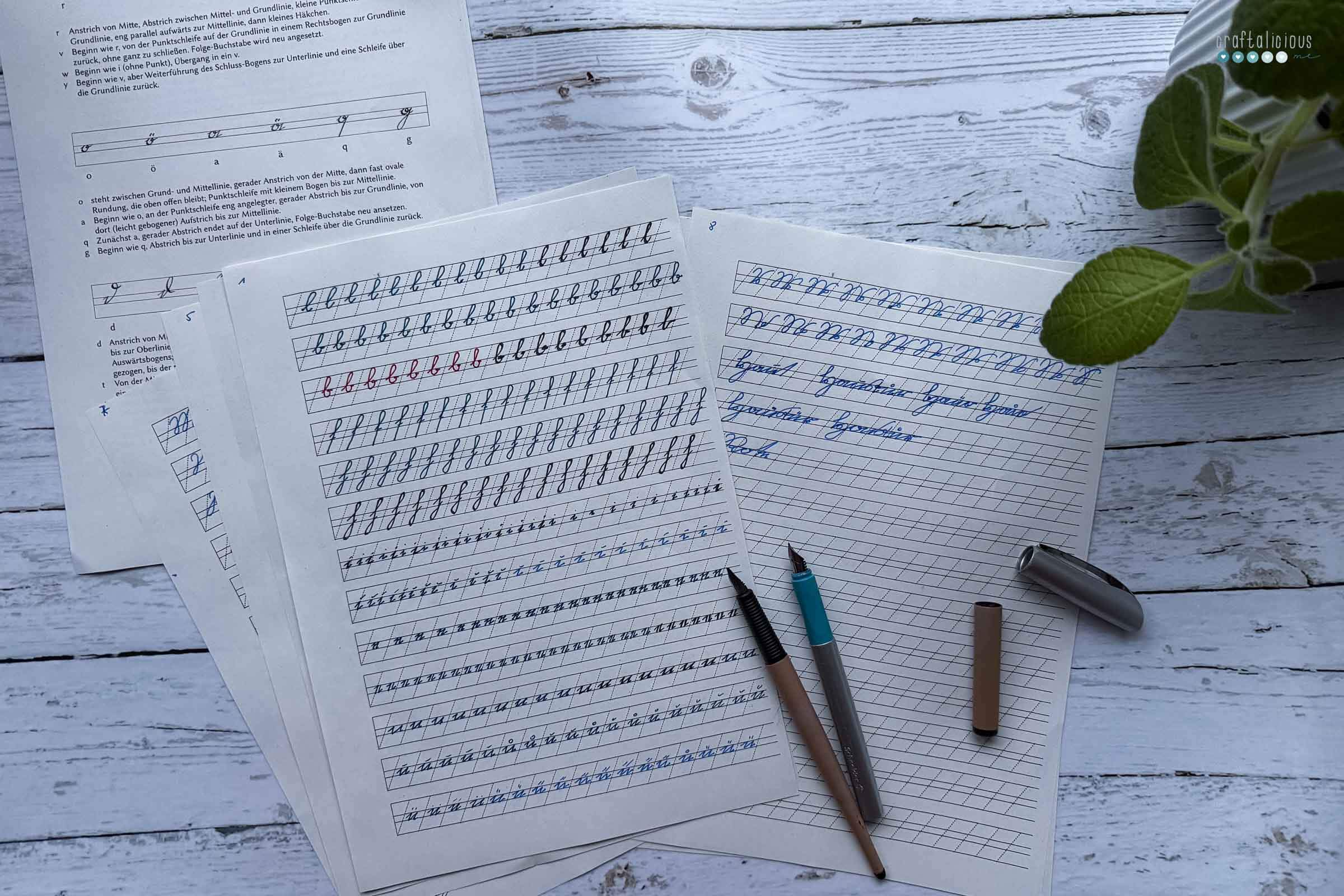
Last weekend I had booked myself a script workshop at the community college. For one I wanted to cross of another goal on my 101 in 1001 bucket list but even more so I love learning stuff. And German Kurrent and Sütterlin is something I came a cross before.
I remember a time when I looked at my grandma’s writing and told her that she was writing the letters wrong. Only then did she tell me that she learnt it differently. She had learnt Sütterlin in school. I found it funny as a kid (I must have been around 3rd grade I assume) that her s looked like an f. So she found me an old notebook and scribbled down the alphabet. And I played around a bit. I still have that notebook somewhere with my writing attempt.
In 1911 Graphic artist Ludwig Sütterlin was commissioned by the Prussian Ministry of Science, Art and Education to create a modern handwriting script. The idea was to simplify the Kurrent script that had been around since the 16th century. The script was taught in schools from 1915-1941. With the rise of the Nazi regime it was forbidden to write arguing that it was a Jewish script. Which is obviously BS when a Prussian artist came up with it.
A few years back I leafed through a photo book and one photo fell out and revealed some text on the back. I was not able to decipher it completely. So when I saw a course that taught you writing and reading the scripts I thought that was perfect.
We started the course with a bit of historical background and the distinction between the two scripts.
Kurrent is an old form of handwriting used for writing the German language. Evolving out of late medieval cursive writing, many individual letters acquired variant forms over the long history of its use into the first part of the 20th century. With a few alterations it was used in Scandinavia – called „Gotisk skrift“ – until 1875. The writing was typically done with a quill.

practicing letter h in German Kurrent – I think it’s my favorite
The following helps to distinct the script types:
Kurrent
Sütterlin
- written in 30° angle (depending on personal preference 15-45°)
- written in 2:1:2 distribution meaning the main part of the letter is in the middle and the upper and lower parts of letters are more elaborate
- written with a quill or nib pen (Bandzugfeder)
- written with no angle
- written in 1:1:1 so less elaborate ups and downs
- written with a nib pen (but a different one – German has two words for nib) (Gleichzugfeder)
The angle is one of the most distinctive things. It had to do with the new metal quills that were introduced. Also, as I mentioned above this script was used for the German language. Back then many words were also in Latin or French. These were written with Latin letters (like today). Also names and locations were usually written in Latin letters. So it is very different to read today.
I had a lot of fun in this course. Of course I am nothing but fluent and had to look up about every letter when we tried to write one word. So it needs a lot of practice.
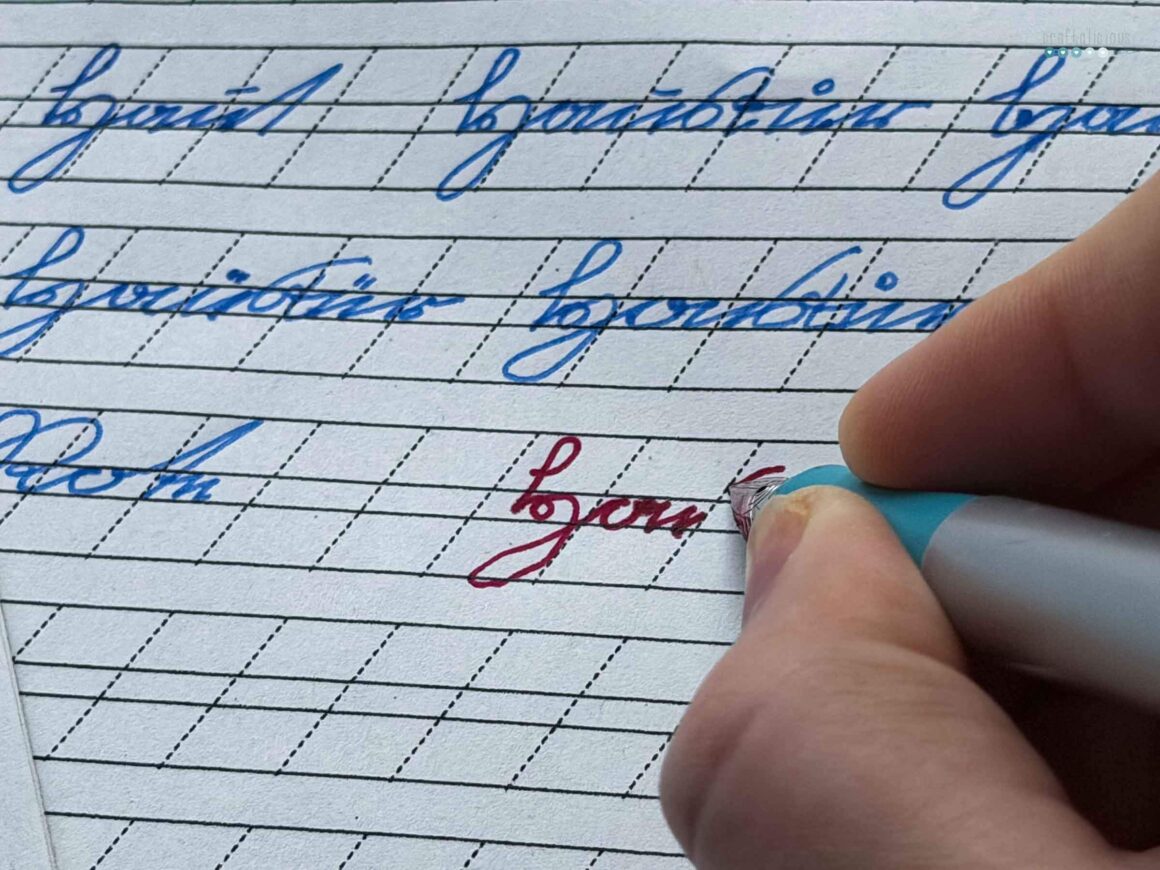
my wobbly attempt in writing Haustür (house door)
The approach from the teacher was that once you can write it and now how the flow a writing is it will be easier to read and decipher the different handwriting and the quirks that each person has. Funnily enough I had indeed realized that I had a certain way of writing my letter. I like the bottom serves in g, j, z and such.
One thing I still need to study and really understand are the different s-sounds. There are three different ways to write an s. Today we still habe two in the German language (s& ß). There are grammatical rules for end-s and middle word-s and combined-word-s and such.
Now I will need to find some time to keep practicing. I was wondering if I could write a card to my god child with a legend. It would be fun to have a secret code. Well, it wouldn’t be very secret because my sister and brother-in-law most likely are able to read it with their intensive theological research background and obviously this script was used back then. also I will have to check with my parents if there are still some older children book in my late grandparents estate to practice reading. Or I can try and work my way through the images under Wikipedia Commons.
Are you able to write script in general? Have you heard of Kurrent and Sütterlin? Are you able to write it? Do you enjoy typography? Do you still use a nip pen?
